Community-Led Brands: What Happens When Customers Run the Marketing
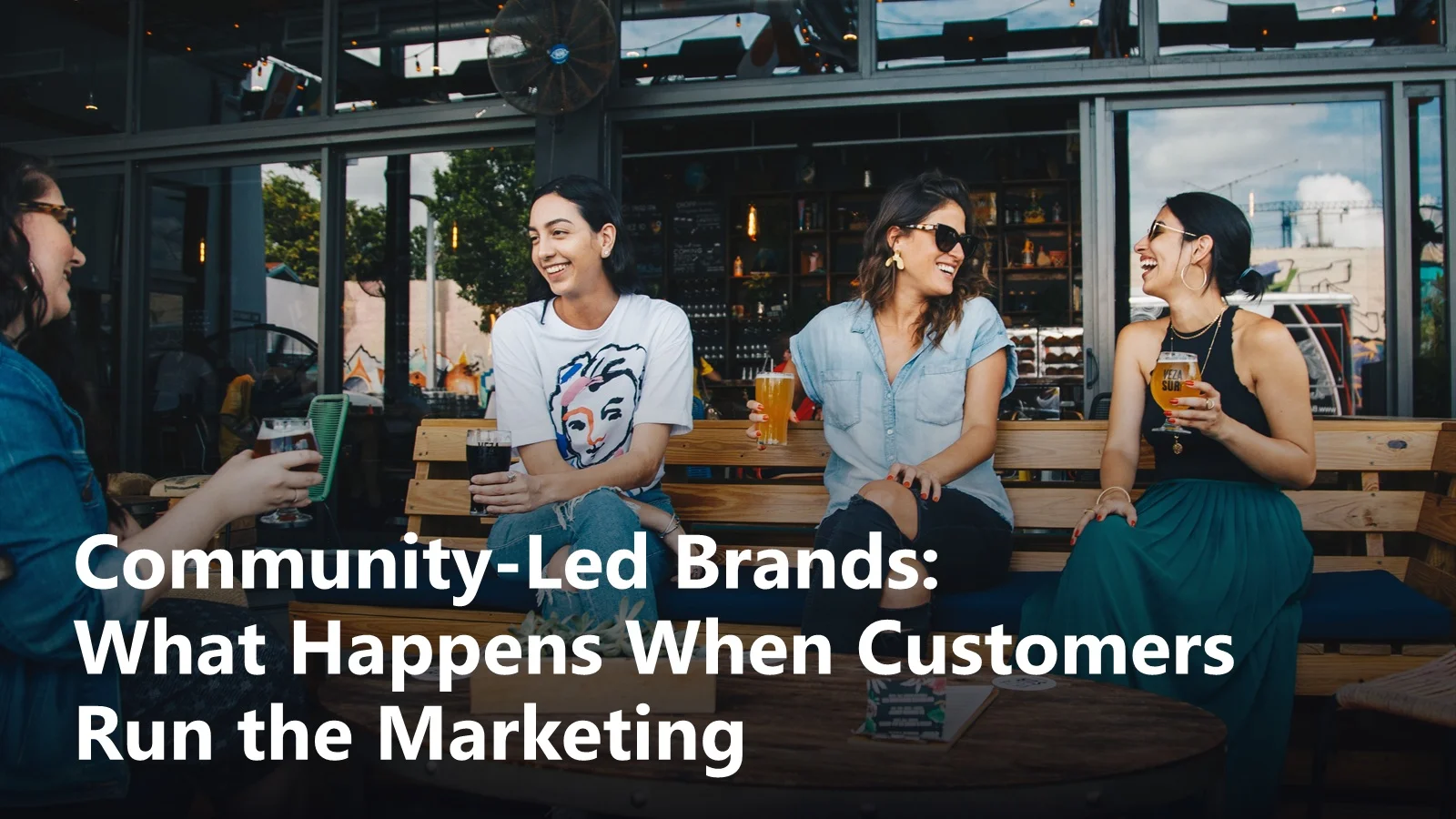
Most marketing still runs on a simple handoff. A brand makes something, publishes it, puts some ad spend behind it, and waits for someone to show up and buy. Once the purchase happens, the job is treated as done, and the customer quietly exits the story. Community-led brands break that handoff on purpose. The customer doesn't just receive the marketing anymore; they start answering other people's questions, sharing their own experience unprompted, and sometimes pulling someone new into the brand before the brand has said a single word about it. The conversation stops starting exclusively with the brand, and that one shift changes what marketing is actually for.
What Is a Brand Community, Really?
A brand community isn't just everyone who happens to follow a brand's account. A follower can see a post, scroll past it, and never think about the brand again until the algorithm serves them another one. A community member has something deeper going on, a real relationship with the brand itself, or with the other people gathered around it. They ask questions, share what actually happened when they used the product, offer recommendations, or simply feel like they belong to the group. A community is best understood as a more deeply connected subset of an audience, not a replacement for one.
There's a nuance worth being precise about here: engagement doesn't require visible activity. A 2017 study of 752 online brand community members, led by researchers Mousavi, Roper and Keeling, found that posters and lurkers (people who never comment or post and just watch) were equally likely to derive a sense of social identity from belonging to the community. That doesn't mean every passive member feels strongly attached. The real dividing line isn't how much someone interacts. It's whether they feel a sense of belonging that goes beyond simply consuming whatever the brand puts out, and that's exactly why people tend to care more about what other people like them have actually experienced than about a brand explaining, yet again, why its own product is good.
Audience or Community? Ask Who's Doing the Talking
There's a quick way to tell which one you're actually looking at. An audience asks "what is the brand telling me?" A community asks "what are people like me actually saying?" Those aren't small variations on the same question.
Picture someone deciding whether to try a new skincare product. They'll read the product page, watch the ad, scroll the brand's Instagram, and most will still check Reddit, text a friend, or search for what other customers actually experienced before they commit. The brand supplies information. Another customer supplies context, and that context tends to feel more reliable precisely because it isn't a scripted sales pitch. None of this means everything a community says is automatically accurate. It means peer-to-peer recommendations work through a different mechanism than brand-controlled messaging ever can. A separate study of 442 online brand community members found that customer-to-customer interaction has a measurable positive effect on brand loyalty, driven largely by how pleasurable the community experience feels and how strongly members identify with it.
Why Would Customers Even Bother Participating?
A community only functions when people get something out of being part of it: product advice, recognition, useful information, early access, or simply the feeling of belonging to a group of people who genuinely care about the same thing they do. That sense of belonging ends up mattering to the brand too, not just the customer. A customer who feels a brand gives them people to connect with, not just a product to buy, tends to build a measurably stronger relationship with it than one who doesn't.
That reframes the whole exchange. It stops being simply brand gives product, customer gives money, and becomes something closer to brand gives value and identity, community gives belonging, feedback and advocacy in return. That second version is where community-led marketing actually becomes strategically interesting, rather than just a nice-to-have.
What Community-Led Marketing Actually Looks Like
LEGO Ideas is one of the clearest working examples. Fans submit their own set concepts, and once a design clears 10,000 public votes, it enters LEGO's formal review process, though reaching that threshold doesn't guarantee production, since the company still weighs brand fit, demand and feasibility before greenlighting anything. The notable part isn't that LEGO has enthusiastic fans; plenty of brands have that. It's that the community's ideas genuinely feed into what LEGO actually builds next, rather than just reacting to whatever already shipped.
Glossier tells a quieter version of the same story. Before the brand launched in 2014, Emily Weiss had already spent several years building Into the Gloss, a beauty publication centred entirely on real people's routines, opinions and product experiences, which Glossier's own materials describe as the direct origin of the brand. There was no formal voting mechanism the way LEGO Ideas has one; instead, years of ongoing conversation gave the brand a genuinely accurate read on what its future customers actually wanted. Different mechanisms, same underlying principle: customers stop being only the destination marketing is aimed at, and start becoming an actual input into what the brand does next.
Why So Much of This Happens Off the Brand's Radar
A lot of brand conversation never touches the brand's own page at all. Someone discovers a product through a creator, asks a friend about it over WhatsApp, searches Reddit for real opinions, and eventually buys after hearing three different people describe their own experience with it, and the brand may never see most of that journey happen. That's a big part of what makes community-led marketing genuinely hard to measure: the conversation moves through DMs, group chats and private communities that simply don't show up on a standard social dashboard.
Invisible doesn't mean unimportant, though. Every time customers exchange information with each other instead of waiting for the brand to make the next move, they're quietly building a second distribution layer the brand never had to pay for. It didn't buy that conversation. It just gave people something worth having in the first place.

Does a Community Replace Paid Media?
Not really, and it's not a particularly useful question to spend much time on. Paid media and community solve different problems entirely. Paid advertising can put a brand in front of someone who's never heard of it. Community gives that same person a reason to stick around, ask questions, learn from other customers, and eventually recommend the product themselves without being asked. There's a real difference between discovering a restaurant through an ad and discovering it because three people whose taste you actually trust mentioned it in the same group chat; both can get you through the door, but the trust underneath each one is built differently.
The more useful question isn't whether community will eventually replace paid media. It's whether a brand can become a little less dependent on paid communication being the only thing doing the convincing. Paid buys reach. A genuinely strong community creates peer discovery, advocacy and loyalty that no media budget, however large, can fully manufacture on its own.
What Actually Makes a Community Work
It isn't the platform. Spinning up a Discord server, a WhatsApp group or a branded hashtag doesn't create a community; it just creates a room where one could eventually exist. The harder question is why anyone would actually want to be in that room. If the only thing happening inside it is the brand posting promotions, there's very little reason for members to keep showing up.
A better starting question is: "What would our customers want to talk to each other about even if the brand wasn’t in the room?" Maybe that's advice. Maybe it's shared interests, product experiences, access or recognition. Whatever the specific answer is, it has to be something beyond “here's another message from the brand,” or the group never becomes a community in any meaningful sense: it stays a list of people who happened to join, which is a very different thing from people who actually want to be there.
Brands Should Moderate Communities, Not Control Them
A community loses a lot of its value the moment every conversation inside it is tightly controlled by the brand. People need room to disagree, question the product, and share experiences that aren't uniformly glowing; otherwise, the space starts feeling like just another advertising channel wearing a community's name. That's not an argument against moderation; unlimited negativity or genuinely harmful behaviour still needs to be managed. The real difference is between moderating a community so it stays useful and controlling it so tightly that nobody inside it feels they actually have a voice. Trust is hard to build when members sense that every opinion gets filtered before anyone's allowed to see it.
Where Creators Fit Into Community-Led Marketing
Creators have an interesting advantage here: they usually already have what most brands are trying to build from nothing, a group of people who voluntarily pay attention to them. When a creator introduces a product, their followers aren't automatically joining a formal brand community, but the existing familiarity with that creator makes the brand feel less like a stranger walking in cold. One person explains the product, others ask questions, people compare notes on their own experience, someone forwards it to a friend. That chain can run from a creator's initial trust, through conversation, into something closer to a real community, and eventually into customers, though it's not a guaranteed funnel, and plenty of creator audiences never develop into anything community-shaped at all.
That's exactly why measuring creator content purely on view count misses a real part of its value. A creator can spark a conversation that keeps running long after the original post has stopped collecting views, and none of that continued conversation shows up in the number everyone defaults to checking first.

Community Can Help Marketing. It Can't Replace Marketing.
There's a tempting idea that once a brand has a genuinely strong community, customers will essentially start doing the marketing themselves. That's not realistic. Community members aren't trained marketers, and they generally don't know how a brand needs to position a product, run a specific campaign, or navigate a particular business objective. Community can amplify marketing. It can't substitute for it.
The more accurate relationship is complementary rather than replacement: the brand builds the product, the positioning and the experience; marketing communicates that value out into the world; creators and customers then add their own experiences, recommendations and conversation on top of it. The brand still has a real job to do here. It simply isn't the only voice doing the talking anymore.
When Does a Brand Actually Have a Community?
This is exactly where follower count turns into a weak, sometimes misleading measure. A brand can have millions of followers and almost no real community behaviour happening underneath them. It can also have a much smaller audience where people genuinely identify with the brand, talk to each other unprompted, and actively recommend it to people outside the group. So, the more useful question to ask isn't how many people follow us. It's how much trust actually exists between the people who do.
A community becomes strategically powerful once customers don't just recognise the brand but trust the people around it enough to listen, participate and vouch for it to someone else. A brand doesn't really have a meaningful community just because it created a group or accumulated followers. It has one once it's earned enough consumer trust and authority that people actually want to belong to the conversation, and once that happens, the brand stops having to manufacture every single interaction itself.
Frequently asked questions
What is community-led marketing?
Community-led marketing is an approach where customers actively contribute to a brand's growth through conversations, recommendations, feedback, content and peer-to-peer interaction, rather than only consuming marketing the brand produces on its own.
What is the difference between an audience and a community?
An audience primarily follows or consumes a brand's content, while a community involves a deeper sense of connection between members and the brand or each other. Even passive members who never post or comment can still draw a sense of belonging and social identity from being part of a community.
Why are brand communities important?
Brand communities can create belonging, peer-to-peer information exchange, engagement and advocacy. Academic research has linked community identification and customer-to-customer interaction specifically to stronger brand loyalty.
Can a brand community replace paid advertising?
No. Paid media is generally better at reaching people who don't know a brand yet, while community strengthens engagement, advocacy and peer-driven discovery once they do. The two tend to work best as complementary parts of a broader strategy rather than substitutes for each other.
How do brands build a genuine community?
By giving people a real reason to participate beyond being marketed to: shared interests, useful advice, recognition, access, product discussion or a genuine chance to influence what the brand does next.
What role do creators play in community-led marketing?
Creators can introduce products to audiences that already trust and pay attention to them. When those audiences start discussing, comparing and sharing their own experiences around the product, creators can help seed the early conversations that sometimes develop into a stronger brand community over time.
More from Brand Marketing