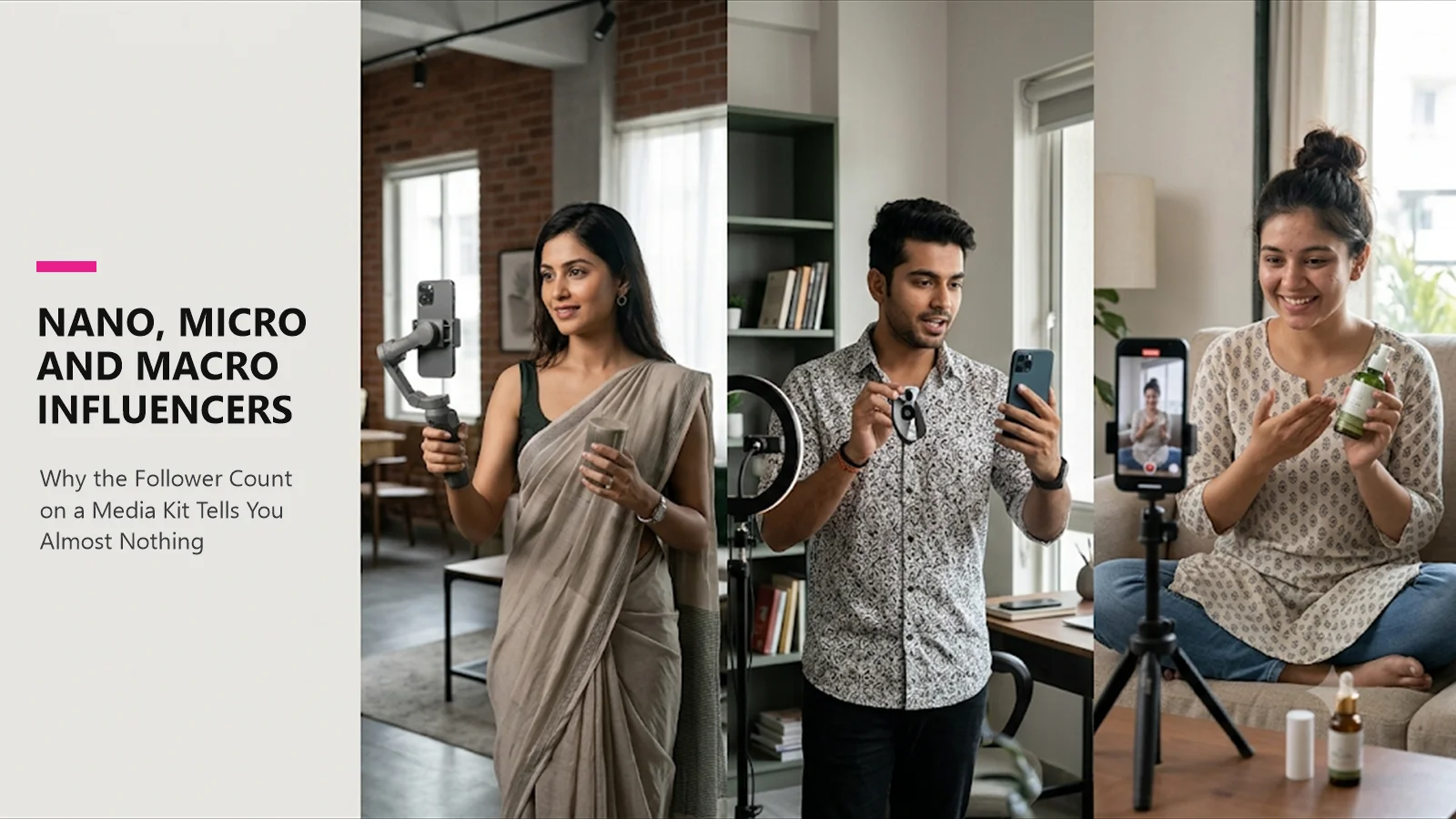
Nano, Micro and Macro Influencers: Beyond Follower Count
You find a creator whose opinion you actually trust. You watch them because the content is good, the take feels honest, and you've never caught them recommending something that turned out to be junk. Then the brand deals start arriving. Every second video is a new product, and somehow every single one is “the best thing I've ever used.” By the fifth one, you're not listening the same way anymore.
That shift from trusting a recommendation to tuning it out has very little to do with how many followers the creator has. It has everything to do with what they did with the audience once brands started showing up.
Most conversations about influencer tiers still start with a number: how many followers, what tier does that put them in, what should that cost. It's the wrong starting point. A creator with a huge following who's burned through their credibility with back-to-back sponsorships is a worse bet than a smaller creator whose audience still believes every word. Tier is a budgeting convenience. It was never a measure of whether a partnership will actually work.

What Nano, Micro, Macro and Mega Actually Mean
The industry sorts creators into rough buckets by audience size, though nobody fully agrees on the exact cutoffs:
| Tier | Follower Range | Engagement Pattern | Generally Best For |
| Nano | ~1,000–10,000 | Highest engagement of any tier — small, often personally known audience | Trust-heavy niches, hyperlocal reach, testing a message cheaply |
| Micro | ~10,000–100,000 | Strong engagement with meaningful reach | Conversion-focused campaigns, niche authority |
| Macro | ~100,000–1,000,000 | Noticeably lower engagement than smaller tiers | Broad visibility, faster awareness at scale |
| Mega | 1,000,000+ | Lowest engagement of any tier, by a wide margin | Mass-market launches, cultural moments |
That table is a sorting tool, not a scorecard. It's fine for building a shortlist or estimating what a campaign might cost. It says nothing about whether a specific creator is actually good at the job. A creator sitting at 15,000 followers who's spent two years building a tight, specific community around home cooking can be worth far more to a food brand than a creator at 150,000 followers whose content wanders across ten unrelated topics. Neither number tells you that on its own; you have to look at who's actually watching and why.
Does a Micro Influencer Beat a Celebrity Endorsement?
It depends on what you're trying to do, and that's really the whole answer. These aren't competing tools; they're different tools.
A celebrity attached to a launch buys attention fast, the kind of visibility that gets a product into a cultural conversation in a way a smaller creator simply can't manufacture. A micro influencer who's spent years talking about running shoes specifically isn't going to generate that same splash, but when someone's actually trying to decide whether to buy, that creator's opinion carries more weight because it comes from inside the category, not from above it.
So the question isn't “which performs better” in the abstract. It's: are you trying to get noticed, or are you trying to get believed? Awareness goals tend to favour bigger reach. Consideration and purchase-intent goals tend to favour creators who are specifically credible in that exact space.
Why Brands Keep Gravitating Toward Nano and Micro Creators
Part of it is simply engagement. EY India's State of Influencer Marketing in India report, published in April 2024 and citing figures attributed to Brand Equity and BW, put average engagement at roughly 4% for nano creators, 2.5% for micro creators and 1.5% for macro creators. Treat that as directional, not gospel; engagement swings hard depending on platform, niche and how a given tool even calculates the number, but the general pattern (smaller audience, tighter engagement) shows up often enough to be worth noting.
There's also a portfolio argument. Instead of putting an entire budget behind one big name, a brand can spread it across several smaller creators who each reach a different slice of the audience, and use that spread to test which message or format actually lands before committing harder.
That flexibility isn't free, though. Ten small creator relationships mean ten briefs, ten rounds of approvals, ten invoices and ten sets of results to track the operational load scales even when the fees don't. A lower per-creator rate doesn't automatically mean a cheaper or simpler campaign once you add up what it takes to run ten of them well.
What Does This Actually Cost?
Honestly: there's no reliable published number worth quoting here, and anyone handing you a clean rate card with exact figures by tier is giving you more confidence than the market actually supports. Creator pricing varies too much by platform, niche, region and individual negotiating position for a single number to mean much. A finance or tech creator in a given tier will often command a real premium over a lifestyle creator in the same tier, and exclusivity, usage rights and whitelisting each add their own separate cost on top of a base rate.
What's actually useful is knowing what moves a quote, rather than memorising a number that'll be stale in six months: the creator's engagement quality (not just follower count), how niche or competitive their category is, what rights the brand is asking for beyond a single organic post, and how much of the brand's identity or distribution the deal leans on. Request current media kits and recent sponsored-post performance directly from the creators you're actually considering that tells you more than any published rate table, because real rates move with the market faster than articles about them do.
So, Does Follower Count Matter At All?
Yes, it's just not the deciding factor people treat it as. It's a rough proxy for potential audience size, which is genuinely useful information. The mistake is stopping there.
Picture a creator at 500,000 followers whose recent sponsored posts are barely getting watched, next to a creator at 40,000 followers whose posts consistently pull strong view counts relative to their following. The smaller account is actually reaching more of the people who follow them, something the raw follower number hides completely.
Even views don't settle it. A skincare brand still needs to know whether that audience actually cares about skincare, or whether they're there for a completely different reason and happen to be watching a sponsored post scroll by. A big, loyal, entertained audience isn't automatically a receptive one for product recommendations; those are two separate questions, and follower count answers neither.
Can Engagement Rate Do the Job Follower Count Can't?
It gets closer, but it has its own blind spots. A percentage that bundles likes, comments, saves and shares together treats all of them as equally meaningful, which they aren't. A genuine product question in the comments is a very different signal than a string of fire emojis, and neither one is a purchase.
A creator can have a high engagement rate and be excellent at sparking conversation without that conversation ever turning into a sale. Another creator might generate a quieter comment section but reach people who are much further along in actually wanting the product. Engagement rate alone can't tell those two apart.
The more useful move is reading engagement next to other signals: average views across recent posts, how sponsored content specifically performs compared to organic content, who the audience actually is. For campaigns built around sales, that means layering in tracked clicks, discount-code redemptions and acquisition cost, because that's the layer that actually tells you whether the partnership paid for itself.

The Metric Nobody Puts on a Media Kit: Do People Believe This Creator?
Here's the part that doesn't show up in any dashboard: whether the audience actually believes what the creator is telling them.
As a viewer, you're not doing follower-count math before deciding whether to trust a recommendation. You're responding to whether the content feels honest, whether this specific person's opinion has ever been useful to you before. That instinct doesn't correlate with audience size in either direction. A tiny creator can be pushing products they've barely touched. A creator with a million followers can have genuine, demonstrable expertise in a category and communicate it in a way that lands. Audience size predicts none of that.
What does erode it, at any tier, is the pattern of constant enthusiasm: every product is the best one yet, every post another five-star verdict. Once an audience notices that pattern, each new recommendation gets discounted a little more, because the creator has stopped signaling which products actually earned the praise.
Getting a creator to say your brand name on camera is the easy part. Giving their audience an actual reason to care is the part that determines whether the deal was worth doing.
Which Tier Actually Delivers the Best Return?
Honestly, none of them and anyone pitching you a universal answer, is selling something. The right tier depends on what this specific campaign needs to do, not on which one won in somebody else's case study.
A nano creator gets you into a small, specific community, but don't let the tier do that work for you; check the actual content and whether that audience fits before you assume it does. A micro creator usually offers the strongest niche fit, though it's worth confirming their posting history actually backs up the niche they claim rather than taking it on faith. A macro creator buys broader visibility, which only pays off if that visibility is reaching people who'd plausibly care about the product in the first place. And a mega creator or celebrity buys scale and a cultural moment, but that's the tier where it matters most to weigh the total cost against the whole campaign budget, not just the number on the deal sheet.
And wherever you land, the quoted fee is never the whole bill. Production, usage rights, campaign management, any paid push behind the post it all stacks on top. Skip that math, and you end up comparing creators on the one number that tells you the least about what the partnership actually cost.
How Many Creators Should One Campaign Actually Use?
There's no formula that fits every brief, but the goal should drive the count, not the budget alone. For a brand testing a new market or message, spreading a modest budget across several smaller creators enough to see the message land in a handful of different audiences tends to teach you more than putting the same money behind one bigger name. For a tightly measured, sales-driven push, a smaller number of carefully matched creators with their own trackable links or codes gives you cleaner data than a large, loosely coordinated group ever will.
A sensible default for most brands running an ongoing program leans heavily toward micro creators for the bulk of volume and engagement, uses macro creators sparingly for the moments that genuinely need broad visibility, and keeps a small slice of nano creators in rotation for testing new niches or markets cheaply. Treat that as a reasonable starting shape to adjust, not a ratio to follow; the actual split should move with what a given campaign is trying to prove.
A Better Way to Pick a Creator Than “How Many Followers”
Four questions do more work than a follower threshold ever will.
Does the audience actually fit the product? A large following only matters if a meaningful share of it is the kind of person who'd plausibly buy what you're selling.
Does the creator's existing content fit the brand? One viral clip isn't a track record. Look at what they've been posting for months, not the one outlier that got them on your radar.
How does their content perform over time, specifically the sponsored posts? Recent, consistent performance on paid content is a far better predictor than a single standout number from a year ago.
What does this campaign actually need to achieve? Awareness work leans toward reach. Sales work leans toward tracked conversions and acquisition cost. Content-asset work leans toward quality and usage rights. Each goal points toward a different kind of creator, and pretending one tier serves all three is how budgets get wasted.
What This Means for Wyld
This is the exact sorting problem a creator and UGC marketing platform should be built to solve, not by defaulting to whichever tier has the best unit economics on paper, but by matching creators to briefs on fit first. A platform that lets brands filter by follower count alone is solving the easy 20% of the problem and leaving the part that actually determines campaign success, audience relevance, content consistency, whether an audience still believes this creator entirely up to guesswork.
The brands that get real value out of creator marketing over time are the ones treating tier as one input among several, not as the filter they apply before looking at anything else. The job isn't finding the creator with the most followers available at the right price. It's finding the creator whose audience was already going to care about this specific product, and giving them room to say so in their own voice.
Frequently asked questions
What's the difference between nano, micro, macro and mega influencers?
Mainly follower count. Nano creators typically sit around 1,000–10,000 followers, micro creators around 10,000–100,000, macro creators around 100,000–1,000,000, and mega creators above 1,000,000. These bands shift depending on who's defining them, so treat them as rough guidelines rather than fixed rules.
Is a micro influencer more effective than a celebrity endorsement?
Not inherently they do different jobs. Celebrities and macro influencers tend to win on broad visibility; micro influencers tend to win on niche credibility and purchase-stage trust. Which one is “more effective” depends entirely on what the campaign is trying to achieve.
Why do brands keep choosing nano and micro creators?
Often for tighter engagement within specific communities and the ability to test several audiences and formats at once. That said, smaller audiences don't guarantee results; each creator still needs to be evaluated on relevance and content quality, not just tier.
Does follower count still matter?
Yes, as a rough signal of potential reach, but it needs to be read alongside audience relevance, recent content performance and engagement quality, not relied on by itself.
Is engagement rate a better metric than follower count?
Neither works alone. Follower count hints at potential reach; engagement rate hints at how actively an audience interacts. Reading them together, against the actual campaign goal, tells you far more than either number in isolation.
Are smaller creators more authentic than bigger ones?
Not automatically. Authenticity tracks how genuinely a creator engages with a category and how consistently they communicate it, not with their follower count. Plenty of small creators promote things they barely use; plenty of large creators have real category expertise.
Should a brand run one big creator partnership or several smaller ones?
It depends on the goal. One larger partnership is simpler to run and can deliver broad exposure in one move. Several smaller partnerships cost more to manage but let a brand reach distinct communities and test messaging before scaling what works.
How much do influencers typically charge?
There's no reliable universal number; rates vary too widely by platform, niche, region, and the specific rights being requested to quote meaningfully. The more useful approach is requesting current media kits and recent sponsored-post performance from the actual creators you're considering, rather than anchoring to a published rate card.
How many influencers should a brand use in one campaign?
It depends on the goal, not a fixed rule. Testing a new audience or message favours spreading a budget across several smaller creators. A tightly measured, sales-driven campaign favours fewer, carefully matched creators with their own trackable links for clean attribution.
More from Nano & Micro Influencers