Google Isn't Just Sending You to Answers Anymore. It's Becoming the Answer.
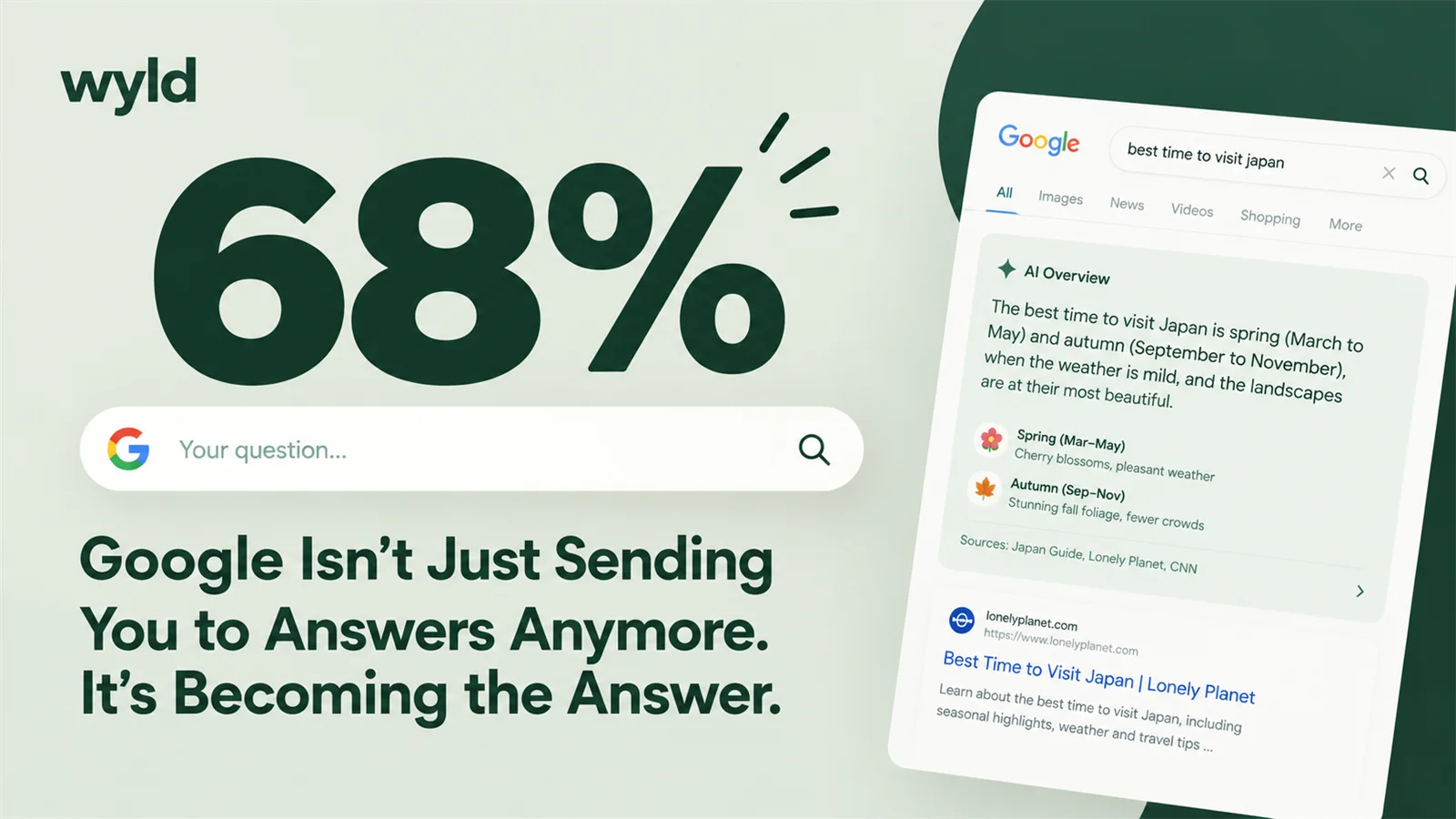
Type a question into Google today, and there's a decent chance you'll never leave the results page. Not because you gave up. Because you already got what you came for.
Research firm SparkToro pulled clickstream data from Similarweb and found that 68.01% of U.S. Google searches in the first four months of 2026 ended without a single click. Two years earlier, that number sat at 60.45%. Back in 2019, it was closer to 49%. Put plainly, roughly 680 out of every 1,000 U.S. Google searches ended without a click, and only around 232 clicks per 1,000 searches reached the open web.
Worth flagging: SparkToro itself notes that the 2024 and 2026 figures come from different measurement panels. The earlier number came from its Datos panel, while the newer one came from Similarweb, so the jump is not a perfectly clean apples-to-apples comparison. The direction of the trend is well supported across multiple independent sources; the exact size of the year-over-year jump is a little less certain than the headline number suggests.
That's not a glitch in the data. It's a redesign of what a search result is supposed to do.
What Counts as a Zero-Click Search?
A zero-click search is exactly what it sounds like. You search, you get your answer, and you never click through to another page. Sometimes that's a flight status. Sometimes it's a currency conversion, a store's closing time, or a quick fact Google can surface directly on the results page. Increasingly, it's a short AI-written summary sitting above everything else.
None of this is new behaviour, exactly. Featured snippets, knowledge panels and map results have been keeping people on Google's own page for years. What's changed is the scale and the sophistication of what Google can now answer without you going anywhere.
Classic SEO runs on a simple chain: search, click, land on a website, take an action. Zero-click search doesn't break that chain so much as skip the middle two steps. The search still happened. Your content may have even been the source. The click just never came.
Why This Jumped So Fast
AI gets most of the credit for this shift, and it deserves a lot of it, but it's not acting alone.
Google has spent close to a decade building features that answer questions directly on the results page, long before generative AI entered the picture. AI Overviews are really just the most aggressive version of an idea Google has been testing for years. Why point someone toward an answer when you can hand it to them directly?
The practical effect is that the search results page itself has stopped being a signpost and started acting like the destination.
What an AI Overview Actually Does
An AI Overview is a short, AI-generated summary Google places above the regular results for certain searches, usually with source links underneath or woven into the text.
Say someone searches "what should I pack for a trip to Iceland in winter." A traditional results page hands them ten separate articles to dig through. An AI Overview can pull layering advice, weather expectations and gear recommendations into one answer before they've clicked anything at all.
From the searcher's side, that's a genuine convenience.
From a publisher's side, it raises an uncomfortable question: if Google already summarised the answer, why would anyone still click through to read the full article?
Does the Data Actually Back This Up?
Mostly, yes, though the size of the effect depends heavily on who's measuring it and how.
Pew Research Centre tracked the real browsing behaviour of roughly 900 U.S. adults across close to 69,000 Google searches in March 2025. When an AI Overview appeared, people clicked through to a standard search result in just 8% of visits, compared with 15% when no AI summary showed up. Clicking a link from inside the AI summary itself happened in only about 1% of visits. Google publicly disputed Pew's methodology after the study's release, calling the queryset unrepresentative of search traffic overall, which is a dispute worth noting, though it doesn't change what Pew's panel actually observed.
A 2026 field experiment went a step further. Researchers Saharsh Agarwal (Indian School of Business) and Ananya Sen (Carnegie Mellon's Heinz College) built a Chrome extension, randomly assigned 1,065 desktop users to see Google either with or without AI Overviews, and ran the test for two weeks per participant. When an AI Overview appeared, outbound clicks to publisher sites dropped by 39.8%, and the odds of a zero-click search rose by 34.5%. Because participants were randomly assigned rather than simply observed, the researchers could call this causal rather than just correlated, a meaningfully stronger claim than an observational study, though worth noting this result is currently a working paper posted to SSRN, not yet a peer-reviewed publication.
Ahrefs ran a much larger dataset, covering 300,000 keywords: 150,000 that triggered an AI Overview and 150,000 informational keywords that did not. For the keywords that triggered an AI Overview in December 2025, the average click-through rate for the No. 1 organic result fell from 7.3% in December 2023 to 1.6% in December 2025. However, that raw decline is not the same as the estimated impact of AI Overviews alone. After accounting for falling click-through rates on comparable informational searches without AI Overviews, Ahrefs estimated that the presence of an AI Overview was associated with a 58% lower click-through rate for the top-ranking result than would otherwise have been expected. An earlier version of the same study, from April 2025, found a 34.5% reduction, which suggests the effect may be intensifying over time rather than settling.
Google, for its part, disputes the idea that it's quietly strangling the open web. The company maintains its overall click volume to websites has stayed relatively stable year over year, and argues that AI-powered search actually generates more total queries, which can mean more and sometimes better traffic for some sites.
The honest version of this story isn't "AI killed SEO." It's that the link between showing up on Google and actually getting clicked has gotten a lot less dependable.
Why Would Google Rather Just Tell You?
Because for a lot of questions, that's genuinely what people want.
Nobody searching for a unit conversion or a public holiday date wants to read 1,200 words to get there. For straightforward, factual questions, a click can feel like friction Google is simply removing. That reframes what a search engine is actually for. Google isn't only pointing you toward websites anymore. It's increasingly deciding, on your behalf, whether you need one at all.
Not every search ends at the summary, though this is where the doom narrative gets too simple. A one-paragraph answer works fine for a quick fact. It works a lot less well for a decision that actually takes thought. Choosing a laptop, planning a trip, picking a skincare routine for a specific skin type. Those searches still tend to pull people toward comparisons, reviews and other people's real opinions, not just a tidy summary.
Pew's own data reflects exactly that pattern. Even when an AI Overview showed up, people still clicked through to websites. Just a lot less often than when no summary appeared at all.
What This Means If You're Trying to Get Found
Here's the part worth sitting with if you're a brand, a marketer or a creator trying to be discoverable right now.
For years, the entire SEO playbook assumed the click was the prize. Rank high enough, and the traffic follows. That assumption is getting shakier by the month. Ranking well no longer reliably means getting seen by a human who then visits your site. You can hold the top organic spot and still watch a shrinking share of searchers ever reach you.
Being the source an AI Overview quotes or summarises still carries real value, even without the click. It's brand visibility and implicit credibility. Google is effectively placing your information in front of a searcher, even if that searcher never lands on your page. Writing content that's structured clearly enough to be quotable inside a summary, a direct answer near the top, concrete numbers, and a clean definition is a different skill than writing for a scroll-and-read audience, but it's becoming just as important.
It's worth a brief mention, too, that some of the attention a zero-click results page no longer sends to websites is simply showing up elsewhere: a creator's demo video, a community thread, a shoppable post someone acts on without opening a search bar at all. That's a real shift in where discovery happens, but it's a separate topic in its own right rather than the main argument of this piece.
The brands adapting well to the zero-click shift aren't abandoning search. They're treating it as one entry point among several, rather than the single front door it used to be.
In practice, that means building discovery in places a summary cannot replace. A UGC creator showing a product in use, the choice between UGC and influencer marketing, and a UGC platform for finding and managing those creators all work outside the results page.
How Do You Actually Optimise for AI Overviews?
Strategy aside, there are concrete things that change how a page gets written once the goal shifts from "win the click" to "be the source worth quoting."
Put the actual answer first, in plain language, before the supporting detail. A 40- to 60-word answer sitting right under the heading with no unnecessary setup is far easier for a summarisation model to understand than an answer buried three paragraphs into a narrative introduction.
Write headings the way people actually ask the question, not the way a copywriter would phrase a section title. "How much does X cost?" is more useful than "Understanding the Investment."
Keep one idea per heading. A section that answers three different questions at once is harder to summarise accurately than three short sections that each answer one.
Anchor claims to specific numbers, named sources and dates rather than vague language. "Research suggests" is less useful than "Pew Research Centre found X in March 2025." This article leans on that principle throughout. The statistics are attributed by name and date rather than paraphrased loosely.
Use structured data for housekeeping, not as a tactic. Google says there is no special schema.org structured data you need to add to appear in its AI features, and FAQ rich results no longer show in Google Search at all. Matching any markup to the visible text on the page is still good practice, but clear headings and useful, direct answers do far more of the work.
None of this guarantees a citation inside an AI Overview. But it's the difference between writing content that's merely accurate and content that's actually built to be understood and extracted. In a search landscape where the click is no longer the default outcome, that's becoming a much more realistic goal.

Frequently asked questions
What is a zero-click search?
A zero-click search is a Google search where the person gets the information they need directly on the results page, without clicking through to any website. This can come from a quick fact, a featured snippet, a knowledge panel or an AI Overview.
What percentage of Google searches end without a click?
According to SparkToro's analysis of Similarweb clickstream data, 68.01% of U.S. Google searches ended without a click during the first four months of 2026, up from 60.45% in 2024, though SparkToro notes the two figures come from different measurement panels, so the exact size of the increase is somewhat less certain than the headline comparison suggests.
Do Google AI Overviews actually reduce website clicks?
Multiple independent studies suggest they do, though estimates vary by methodology. Pew Research found click-through to standard results dropped from 15% to 8% when an AI Overview appeared. A 2026 randomised field study from researchers at the Indian School of Business and Carnegie Mellon University found outbound clicks fell 39.8% (currently a working paper, not yet peer-reviewed). Ahrefs estimated that click-through for top-ranking pages was 58% lower than expected in its most recent update. Google disputes that this amounts to an overall traffic decline, saying its total click volume has stayed relatively stable year over year.
What is AI Overview SEO?
AI Overview SEO refers to optimising content so it's more likely to be understood, summarised, cited or quoted inside Google's AI-generated search summaries, rather than optimising purely to win a click. It typically involves clear, direct answers near the top of a page, specific figures and well-structured definitions.
Does zero-click search mean SEO is dead?
No. It means the relationship between ranking well and receiving a click has become less reliable, not that ranking stopped mattering. Complex or high-consideration searches can still lead to clicks, and appearing inside an AI Overview can still create brand visibility even without one.
More from Brand Marketing