Is AI-Generated UGC Replacing Human Creators?
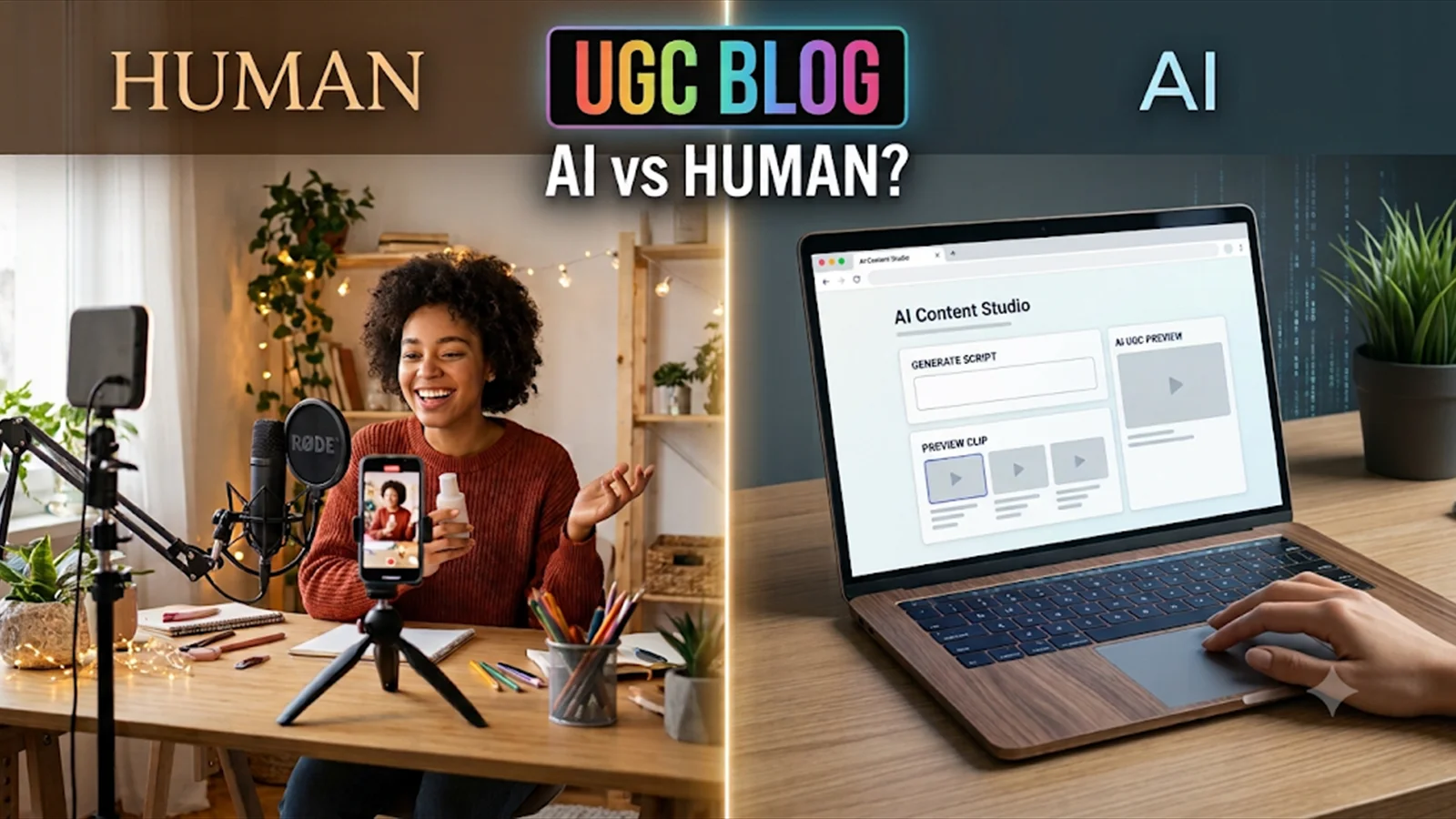
AI can write the script, generate the person on screen, produce the voice, edit the footage and spit out a dozen variations before a human creator has finished filming a single take. So, it's a completely fair question for a brand to ask: if AI can produce UGC faster and cheaper, why keep paying human creators at all?
The honest answer isn't that AI-generated content is “fake” and human content is automatically “real.” The more useful question is whether the person watching it will actually perceive it as authentic. That distinction matters because UGC was never valuable simply for looking like something a customer made. Its value comes from the sense that a real person had a real experience with a product and is now passing that experience on to someone else, which is exactly where AI can assist UGC production without necessarily replacing the human being behind it.
What Is AI-Generated UGC?
AI-generated UGC is content created partly or entirely with artificial intelligence, built to replicate the style of ordinary user-generated content. That could mean an AI-generated person talking through a skincare routine, a synthetic voice delivering a testimonial, or a system producing multiple product videos without any human ever appearing on camera.
There's an important line between AI-assisted UGC and fully AI-generated UGC. A real creator can use AI to brainstorm hooks, edit footage, add captions, trim pauses, build variations or adapt a video across formats, and the creator still experienced the product, the opinion still came from them, the story is still theirs. AI simply helped turn that idea into content more efficiently. The situation gets genuinely more complicated once AI stops helping produce the content and starts playing the creator instead.
AI Can Make UGC Look Human. That Doesn't Mean People Will Trust It.
This is where the conversation around AI UGC tends to get oversimplified. A video can look completely natural and still leave an audience quietly wondering whether there's a real person behind it, and that gap matters more, not less, as synthetic content keeps improving.
Picture an AI-generated woman saying, “I've been using this serum for three weeks, and my skin has completely changed.” The lighting looks natural, the expressions look realistic, even the small imperfections that make UGC feel casual are all present and accounted for. There's just one problem: she never used the serum. There was no three-week period, no real reaction, no actual decision about whether she liked it or not. The content can look exactly like UGC while the experience it's communicating simply doesn't exist, which is a fundamentally different situation from a real creator who used the product and then used AI to polish the footage afterwards.

The Real Question Is Perceived Authenticity
Asking whether AI-generated UGC is “authentic” isn't actually the most useful framing. The sharper question is whether people will perceive it as authentic, because consumers never have access to everything that happened behind a piece of content; they're only judging what they can see and hear. They're looking for signals: does this person understand what they're talking about, have they clearly experienced the product, does the reaction feel believable, does the recommendation fit who they seem to be, would they probably say something similar even without being paid to?
Those signals are what build perceived authenticity. But once audiences understand how easily AI can now manufacture a person, a voice, or even an apparently spontaneous reaction, simply looking human may stop being enough on its own, which changes what brands actually need to be thinking about when they commission UGC going forward.
AI Should Be the Tool Behind UGC, Not the Face of the Recommendation
There's nothing inherently wrong with using AI in UGC production. It can make creators meaningfully more efficient, developing ideas, testing hooks, editing footage, generating captions, building variations, localising content, speeding up the repetitive parts of the job nobody particularly enjoys. That's a legitimate use of the technology, because it's helping the creator execute an idea they actually had. The creator stays the creative source. The experience stays theirs. The recommendation stays theirs.
The problem starts specifically when AI begins fabricating the parts of the content an audience assumes came from an actual human being. A useful way to think about the line: AI can assist the production. The human should own the experience. AI can run the backend. The creator stays the creative face and the actual recommendation behind the brand.
What Makes Human UGC Valuable?
Human creators were never valuable simply for making imperfect-looking videos. A badly shot clip isn't automatically authentic, and deliberately making content look rough doesn't manufacture trust on its own. What actually matters is what exists behind the footage.
Experience
A creator can describe what happened when they used a product because they genuinely used it, what surprised them, what they liked, what they didn't, and who they think it's actually suited for. That lived experience is what gives a recommendation real substance instead of just surface polish.
Relatability
People don't need a creator who looks flawless. They need someone whose situation, personality or perspective feels genuinely relevant to their own. A creator who naturally speaks to a specific audience makes a recommendation, and in a way, an artificially engineered, universally appealing face never quite manages.
Creativity
The strongest UGC creators are more than people willing to hold a product in front of a camera. They know how to turn an ordinary brief into something worth watching: an unusual hook, a witty aside, a relatable situation, a genuinely unexpected way of introducing the product. AI can generate a pile of possibilities. A human creator still has to decide which one is actually worth making.

The Problem With “Make It Look Authentic”
For years, brands have tried to make UGC feel deliberately less polished: handheld cameras, natural lighting, casual language, small mistakes left in, unscripted delivery. AI can now reproduce most of those visual and behavioural cues convincingly, which means brands may need to stop treating imperfection itself as proof that something's real. A shaky camera doesn't prove a person exists behind it. Neither does an awkward pause, a cluttered bedroom background, or even a reaction that looks spontaneous. The more useful question is whether there was actually a person behind the experience being shown, which is a much harder thing to fake convincingly, because it was never really a visual style in the first place. It's the story underneath the content.
What Happens When AI UGC Gets More Realistic?
This is where things get genuinely interesting for brands. The better AI gets at producing convincing human content, the harder it becomes for an audience to tell what they're actually looking at. That doesn't automatically mean people reject AI outright; consumers already use AI-powered products daily, and creators are increasingly folding AI into their own workflow without anyone blinking.
The concern runs differently. People may be entirely comfortable knowing AI helped edit a video. They're likely to feel very differently about discovering that the person recommending the product never actually existed, or never used it at all. The technology itself probably isn't the real problem. The gap between what an audience assumes happened and what actually happened is, and that gap is exactly where trust breaks.
AI Influencers and AI-Generated UGC Aren't the Same Thing
AI influencers can work precisely because their appeal comes from entertainment, novelty, storytelling, or the fictional character itself. Nobody follows a fictional AI personality because they believe the character genuinely used every product it promotes; the audience already knows what they're watching.
UGC carries a different commercial expectation entirely. When a creator says “I tried this and here's what I think,” the entire recommendation is built on an implied real experience. That's exactly why an AI influencer and AI-generated UGC shouldn't be treated as the same category of thing. One is openly a fictional personality. The other is usually trying to replicate the communication style of an actual customer or creator, and that difference matters enormously when the entire selling point is personal experience rather than entertainment.
So, Is AI-Generated UGC Replacing Human Creators?
Not completely, but it will almost certainly replace parts of what human creators currently spend their time on. There's little reason for a creator to burn hours on repetitive editing when AI can handle it in minutes, and no real reason to avoid using AI to generate hook variations, adapt a single video across formats, or speed up the parts of production that have nothing to do with the creator's actual judgment or experience.
What AI can't convincingly replace is the part that makes UGC worth paying for in the first place: an actual person who used the product, formed a real opinion, and is choosing to share it. That's not a production task. AI can absorb the way it absorbs editing or caption-writing. It's the entire premise the format is built on. As AI-generated content keeps getting harder to visually distinguish from the real thing, the line brands will increasingly need to protect isn't how polished or rough a video looks; it's whether there's a genuine human experience sitting underneath it.
AI is going to keep taking over more of the production work behind UGC, and brands should let it. What it shouldn't be allowed to take over is the one thing that made UGC worth trusting in the first place: a real person, with a real reaction, telling the truth about what actually happened.

Frequently asked questions
What is an AI-generated UGC?
AI-generated UGC is content created partly or entirely using artificial intelligence, designed to look and sound like traditional user-generated content such as reviews, testimonials, unboxings or demonstrations.
Is AI-generated UGC replacing human creators?
AI is replacing some of the production work traditionally handled by creators, particularly editing, hook variations and repetitive formatting. It doesn't automatically replace the real experiences, opinions and credibility that human creators bring to a recommendation.
What's the difference between AI-assisted UGC and fully AI-generated UGC?
AI-assisted UGC involves a real creator who actually used the product, with AI helping edit, caption or adapt the content. Fully AI-generated UGC uses AI to create the person, voice or experience itself, without any real human having used the product being discussed.
Can AI-generated UGC be trusted the same way as human UGC?
It depends on whether the audience perceives it as authentic, not just whether it looks realistic. Content that visually resembles UGC but represents an experience that never happened can undermine trust once audiences realise the person behind it isn't real.
What's the difference between an AI influencer and AI-generated UGC?
An AI influencer is generally a fictional personality whose appeal comes from entertainment or novelty, and audiences don't assume the character has personally used every product it promotes. AI-generated UGC tries to replicate the communication style of a real customer making a personal recommendation, which carries a different and higher trust expectation.
How should brands actually use AI in UGC production?
AI works best at handling production tasks, editing, captioning, generating variations, and adapting formats, while a real creator's experience and opinion remain the core of the content. Using AI to fabricate an experience that never happened risks the trust the format depends on.
More from UGC & Content Marketing