What Is a UGC Platform? How Brands Find the Right Creators
Brands don't actually need more creators. They need the right ones for the campaign in front of them, and those are two very different problems. As more brands lean into user-generated content, the hard part has shifted from “who can film a video” to “who can make this product feel real to the specific person watching it.” A smaller pool of genuinely relevant creators can be far more valuable than a much larger pool of mismatched ones, and that's really the whole case for a UGC platform in one sentence: it exists to shrink the distance between a brief and the right creator, not to maximise the number of profiles a brand can scroll through. It's also no longer a niche instinct: the IAB projected U.S. creator advertising spend at $37 billion in 2025, up 26% year over year, which is a meaningful signal that brands have already decided this is where budget belongs. The open question for most of them isn't whether to invest in creator content. It's how to find the right creators without that investment turning into a full-time sourcing job.
What Is a UGC Platform?
A UGC platform connects brands with creators who produce content for marketing campaigns, typically letting brands discover profiles, filter by relevant criteria, send briefs, manage collaborations and collect finished content in one place. Unlike traditional influencer marketing, none of that depends on a creator having a large following. A creator with a small, specific audience can still produce content that performs, because the value isn't coming from their reach; it's coming from how naturally they communicate, how well they understand a particular audience, and how convincingly they can make a product feel like part of their actual life rather than an ad read off a script. That's what makes a UGC platform useful to a brand that needs a repeatable way to source content, rather than starting a fresh manual search every time a new campaign comes up.
How Does a UGC Platform Actually Work?
It usually starts with the brand defining what it actually needs: the product, the target audience, the content format, the campaign objective, the kind of creator that would fit, how many deliverables, the timeline, the budget. From there, the platform helps surface creators who match those specifics, the brand shortlists a few, shares the brief, agrees on deliverables, and the collaboration runs its course until the content comes back. The exact mechanics differ from platform to platform, but the underlying job stays the same, making creator discovery and collaboration something a brand can repeat without reinventing the process each time.
For a brand running a single campaign, finding creators manually is manageable. For a brand that needs UGC continuously, manually searching Instagram and TikTok, sending individual messages, re-explaining the brief to each new creator and chasing deliverables becomes a real operational drag fairly quickly. That's the specific inefficiency a dedicated platform is built to remove.
UGC Creator vs. Influencer: What's Actually Different
UGC creators and influencers overlap in practice, but they are paid for different things. An influencer's core asset is their audience. A UGC creator's core asset is the content they make, which the brand uses on its own channels, so follower count shouldn't be the first filter when sourcing UGC creators. A creator with 15,000 followers who speaks naturally to a tightly defined audience can be far more useful for a UGC campaign than someone with 100,000 followers whose tone or audience doesn't fit the product. Independent research points the same way: EnTribe's 2023 survey of more than 1,000 U.S. consumers found 86% were more likely to trust a brand that publishes user-generated content over influencer content.
Does Follower Count Matter for UGC?
Not always. If the goal is content creation, follower count matters less than whether the creator fits the product and delivers quality work. If the goal is reach and distribution, audience size moves back to the centre of the decision.
The 5C UGC Creator Fit Framework
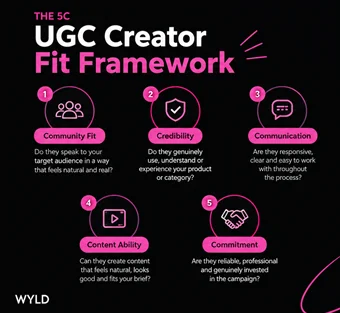
Finding creators is easy. Finding creators who actually fit a campaign is the harder, more valuable skill, and it's worth having a structured way to evaluate it rather than defaulting back to follower count out of habit. Five factors tend to matter more than anything else: community fit, credibility, communication, content ability and commitment.
Community fit
The first question is whether the creator genuinely makes sense for the audience the brand is trying to reach. A creator speaking to college students will naturally sound different from one speaking to new parents or working professionals, and the difference isn't just demographic; it's whether the creator actually understands the culture, language and everyday context of the people watching. A Hindi-speaking creator can be the stronger choice for a Hindi-speaking mass-market audience than a larger creator whose communication style feels distant from that audience, even if the larger creator's numbers look better on paper. The creator doesn't need to imitate the audience. They need to belong naturally in the conversation already happening around it.
Credibility
A creator should have some believable connection to the product or the problem it solves, and this is where a lot of UGC starts to feel artificial. A creator with no obvious relationship to skincare suddenly explaining a highly specific skincare problem is a familiar red flag; the video can be shot and edited perfectly and still feel wrong, because the recommendation itself doesn't hold up. The useful test is simple: would this creator realistically use, understand or experience this product outside the campaign? If the honest answer is no, it's worth reconsidering the fit before production even starts.
Communication
Good UGC shouldn't sound like every other ad running that week. The strongest creators explain a product in a way that feels native to how they actually talk: everyday language, a regional dialect, a particular sense of humour, a conversational rhythm that's clearly theirs. The goal isn't to strip the brand message out of the content. It's to make that message sound like it belongs in the creator's own voice rather than a script handed to them.
Content ability
A creator doesn't need a professional studio to make good UGC, but they do need to understand how to actually hold someone's attention: building a hook, explaining a product clearly, demonstrating an experience, telling a short story, adapting the content to whatever platform it's landing on. The most polished-looking video isn't automatically the most effective one. For a lot of campaigns, a creator who understands how people actually consume content beats a creator who simply shoots beautiful footage.
Commitment
UGC is still a two-way collaboration, and responsiveness, reliability and a willingness to actually absorb feedback all matter as much as the creative skill itself. A creator can produce excellent work and still become difficult to rely on if communication is patchy or revisions get ignored repeatedly. For brands running UGC at any real volume, reliability stops being a nice-to-have and becomes part of what “quality” actually means.
A quick gut-check before approving anyone
Running through all five Cs in detail isn't always practical when a brand is moving fast, so it helps to have a shorter version on hand: does the creator fit the product, does the product fit the creator's audience, does the creator understand the problem the product solves, and would the recommendation still feel believable with the brand's logo removed from the screen? That last question does most of the work. A creator can hit every line of a script and tick every box on the brief, and the content can still read as an advertisement rather than a recommendation. When the creator, product, problem and audience genuinely connect, that usually shows up in the finished content before a single edit gets made, and when one of those four is missing, it tends to show up there too.
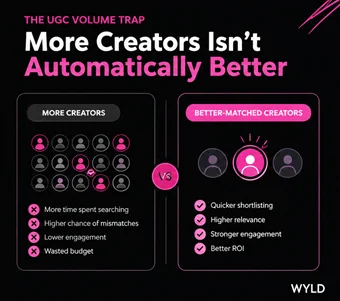
The UGC Volume Trap: More Creators Isn't Automatically Better
One of the most persistent misconceptions about UGC is that more creators automatically means more value. It doesn't. Picture two campaigns: one works with fifty creators who are each a roughly average fit, the other works with five creators who closely match the audience, genuinely understand the product and consistently deliver strong work. The first campaign produces more raw content. The second usually needs less explanation, fewer revision rounds and less quality-control overhead per piece. Neither approach is universally right; more creators make sense when the objective is pure reach or wide creative testing, while fewer, better-matched creators make more sense when the objective is consistently high-quality content.
The real point isn't that five creators always beat fifty. It's that the creator count should follow the campaign's actual objective instead of quietly becoming the objective itself. Treating the size of a creator pool as a stand-in for the quality of a campaign is the trap, and a UGC platform's job should be helping brands find relevant creators, not simply more of them.
Why Micro and Nano Creators Matter to UGC
UGC has made creator selection far less dependent on celebrity-level reach. Micro and nano creators can offer something larger creators often can't: specificity. They tend to speak to a smaller, more defined community and communicate in a way that feels closer to how an everyday consumer actually talks, which matters a great deal when a campaign depends on relatability rather than scale. A brand targeting Hindi-speaking consumers, for instance, may get more out of a creator who communicates naturally in Hindi than from a much larger creator whose audience happens to overlap on paper.
That pattern shows up in independent engagement data, too. EY's April 2024 report on influencer marketing in India found average engagement rates of roughly 4% for nano creators and 2.5% for micro creators, compared with about 1.5% for macro creators. Across those three tiers, engagement falls as audience size grows. That's not a reason to write off larger creators, who still win decisively on raw reach. It's a reason to stop assuming the two numbers move together.
Why Do Brands Use UGC Platforms?
The real advantage of a UGC platform isn't simply access to a list of creators. It's convenient and repeatable. A brand can absolutely build its own creator network from scratch, but doing so takes real time, research, outreach, relationship management, ongoing coordination, and for brands without that infrastructure already in place, a platform removes a meaningful amount of that operational weight. In practice, that shows up as faster discovery instead of starting from a blank search bar each time, more relevant matching through filters built around niche, language, location and content style, easier day-to-day campaign management once briefs and approvals have a structured home, real access to micro and nano creators who'd otherwise be invisible without the right discovery tools, and a path to making content production an ongoing, repeatable process instead of a one-off scramble every time a campaign comes up.
What Should Brands Look for in a UGC Platform?
In practical terms, that means evaluating a handful of specifics: a creator pool that's genuinely relevant and diverse rather than just large, real coverage of micro and nano creators, useful profile detail and filtering, language and audience relevance, straightforward campaign management, creators who actually communicate reliably, an efficient briefing and content workflow, and quality control that goes beyond simply counting creators. None of that shows up on a homepage that advertises its database size.
UGC Platform vs. Influencer Marketplace vs. Influencer Agency
These three models overlap in places, but they're not the same thing. A UGC platform is primarily built around helping brands discover and work with creators for content production. An influencer marketplace generally connects brands with influencers for broader collaborations, often including some discovery and campaign management alongside audience access. An influencer agency typically offers a more hands-on managed service, running some or all of the campaign on the brand's behalf. Which one makes sense depends on what the brand actually wants: a brand that wants control over creator selection and execution tends to prefer a platform, a brand chasing audience distribution tends to look at a marketplace, and a brand that wants an external team to run the whole thing tends to reach for an agency.
Do All Brands Need a UGC Platform?
No, not automatically. Larger brands with established creator databases, internal influencer teams and long-standing creator relationships may already have everything they need to manage campaigns themselves. Smaller or faster-growing brands are usually facing a different problem: building a reliable creator network from nothing takes real time, and finding the right creators repeatedly can eat resources a smaller team doesn't have to spare. For those brands, a platform offers a faster route to creators without having to build the entire network internally. The right call ultimately comes down to campaign frequency, internal resources, the specificity of the creator requirements, and what the campaign is actually trying to achieve.
How Brands Can Get Better Results from a UGC Platform
A platform doesn't remove the need for strategy; it can surface creators, but the brand still has to know what a good fit actually looks like for its specific campaign. Start with the objective: is this about reach, paid-ad creative, message testing, building trust, or creating a reusable content library? Define the audience next, then run candidates through the five Cs: community fit, credibility, communication, content ability, commitment, before locking anyone in. Finally, look hard at the content itself once it comes back: does it feel natural, does the product have a believable place inside the creator's content, does the hook actually make sense for the platform it's running on, would the intended audience genuinely care? The more clearly those questions get answered before creator selection happens, the less likely the whole campaign is to collapse into a pure numbers game.
The Real Value of a UGC Platform
Put the five Cs, the volume trap and the engagement data together, and they all point at the same underlying job a platform actually needs to do: close the gap between a brand saying “we need creators” and a brand being able to say “we know exactly which creators make sense for this campaign.” A database alone doesn't do that. Filtering by follower count alone doesn't do that either, for all the reasons above. What actually closes that gap is a system built to surface fit- the right creator for the right brief-consistently, without the brand having to rediscover that process from scratch every time.
That's the specific problem Wyld is built to solve. Not a bigger database of creators, but a better way to find the right ones: because the strongest UGC strategy starts with fit, not volume, and the strongest UGC platform is the one that makes finding that fit easier, not just bigger.
Frequently asked questions
What is a UGC platform?
A UGC platform helps brands discover and collaborate with creators who produce user-generated content for marketing campaigns. Depending on the platform, it may also support creator filtering, campaign briefs, communication, content management and payments.
How do brands find UGC creators?
A UGC platform is one route. Brands can also use creator marketplaces, agencies, direct outreach on social media, or creators they already know. A platform is most useful when a brand needs creators repeatedly, because discovery, briefs and approvals stay in one place.
What should brands look for in a UGC creator?
Community fit, credibility, communication, content ability and commitment-what this article calls the 5C framework. Follower count can still matter depending on the campaign's objective, but it shouldn't be treated as the primary measure of a creator's value.
Are UGC platforms worth it for small businesses?
They can be, particularly for smaller businesses that need creator content regularly but don't have the time or team to build a creator network from scratch. The value depends on how often campaigns run, the budget available, and the specificity of the creators required.
Is more UGC always better?
No. More creators can provide more creative variation and testing opportunities, but creator quality and campaign fit still matter more than raw volume. The right number of creators depends on whether the campaign is prioritizing reach, creative testing, content quality, or some combination of the three.
How do you choose the right UGC creator?
Start with the campaign objective and target audience, then evaluate candidates against community fit, credibility, communication, content ability and commitment. The creator should also have a believable connection to both the product and the problem it solves.
More from UGC & Content Marketing